
When you visit a DG Club website for the first time, you may notice two options that can look similar but serve completely different purposes: Login and Register.
Choosing the wrong option can make the process confusing, especially if you already have an account and are simply trying to access it from another phone or computer.
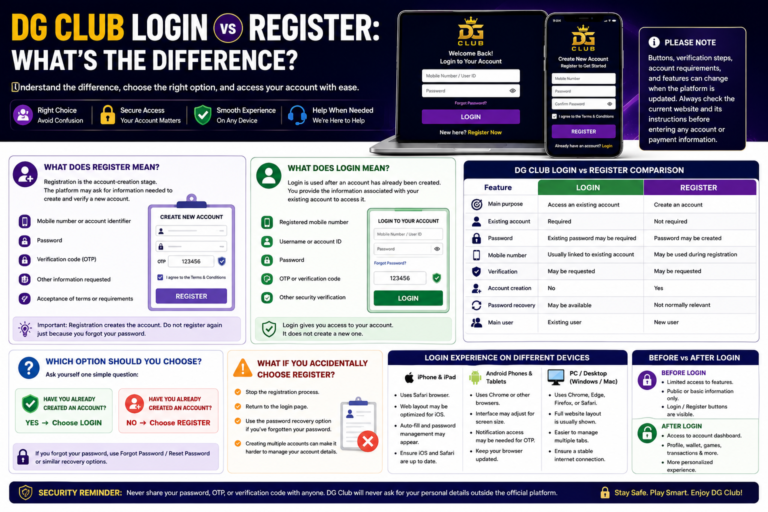
This guide explains the difference between DG Club Login vs Register, how the process can look on iPhone, Android, and PC, and what generally changes before and after you enter your account.
The exact buttons, verification steps, account requirements, and available features can change when the platform is updated. Always check the current website and its displayed instructions before entering account or payment information.
DG Club Login vs Register: The Basic Difference
The easiest way to understand the two options is simple:
Login is for an account that already exists.
Register is for creating a new account.
If you have previously completed registration and still have access to your account details, you would normally choose the Login option.
If you have never created an account, the Register option is the one intended for new users.
These options may appear next to each other, but they begin two different processes.
What Does Register Mean?
Registration is the account-creation stage.
During registration, the platform may ask for information needed to create and verify a new account. The exact fields depend on the current version of the service.
For example, the registration process may involve:
- A mobile number or account identifier
- A password
- A verification code
- Other information requested by the current registration form
- Acceptance of applicable terms or requirements
The important point is that registration creates the account.
You should not normally use registration simply because you have forgotten the password for an existing account.
If an account already exists, look for the available recovery option instead.
What Does Login Mean?
Login is what you use after an account has already been created.
Instead of creating a new account, you provide the information associated with your existing account.
Depending on the current platform, this may include:
- Registered mobile number
- Username or account ID
- Password
- OTP or verification code
- Other security verification
Once the information is accepted, the account area becomes available.
The login screen may look different depending on whether you’re using a phone, tablet, or computer, but the basic purpose remains the same: access an existing account rather than create another one.
DG Club Login vs Register Comparison
| Feature | Login | Register |
|---|---|---|
| Main purpose | Access an existing account | Create an account |
| Existing account | Required | Not required |
| Password | Existing password may be required | Password may be created |
| Mobile number | Usually linked to existing account | May be used during registration |
| Verification | May be requested | May be requested |
| Account creation | No | Yes |
| Password recovery | May be available | Not normally relevant |
| Main user | Existing user | New user |
This distinction is useful because many account-access problems begin with choosing the wrong option.
Which Option Should You Choose?
A quick way to decide is to ask one question:
Have you already created an account?
Yes → Choose Login.
No → Choose Register.
If you created an account previously but can’t remember your password, don’t automatically start registration again.
Instead, check whether the current account-access page provides a Forgot Password, Reset Password, or similar recovery feature.
What If You Accidentally Choose Register?
It can happen.
Someone may already have an account but select Register because they think they need to start the process again.
If you realize that you already have an account, stop the registration process and return to the account-access page.
If you have forgotten your existing password, use the recovery method provided by the platform if one is available.
Creating multiple accounts can also make it harder to remember which mobile number, password, or account information belongs to which account.
Login Experience on iPhone and iPad
The account itself does not necessarily become a different account simply because you’re using an Apple device.
What can change is the way the website behaves inside the browser.
On an iPhone or iPad, you may notice differences such as:
- A mobile-sized login layout
- On-screen keyboard input
- Browser-specific cookies and sessions
- Different page scaling
- Mobile verification behavior
- Different handling of pop-ups or browser permissions
If the page does not look correct, first make sure the browser is updated and the page has loaded completely.
Refreshing the page or opening a fresh browser session can sometimes resolve temporary display problems.
Login Experience on Android
Android users may see a similar mobile layout, but the browser and device environment can differ.
Potential differences include:
- Screen size
- Browser version
- Keyboard behavior
- Cached website information
- Browser permissions
- Mobile network conditions
If the page loads correctly but a button doesn’t respond, try refreshing the page.
If the problem continues, test the current page in another updated browser.
The goal is to determine whether the problem is connected to the account or simply to the browser session.
Login Experience on PC
A desktop or laptop provides a larger screen and physical keyboard, which can make entering account information easier.
However, desktop browsers can also develop their own problems.
For example:
- Old cookies may interfere with a session.
- Cached files may prevent a page from displaying correctly.
- Browser extensions may affect certain page elements.
- An outdated browser may have compatibility issues.
If the page behaves strangely on your computer but works normally on your phone, that is useful information.
It suggests that the account may be fine and that the issue could be related to the desktop browser or computer environment.
iOS vs Android vs PC: What Actually Changes?
The biggest difference is usually the access environment, not the purpose of the account.
| Area | iOS | Android | PC |
|---|---|---|---|
| Screen | Mobile | Mobile | Desktop |
| Keyboard | On-screen | On-screen | Physical |
| Browser | Mobile browser | Mobile browser | Desktop browser |
| Page layout | Mobile-oriented | Mobile-oriented | Wider layout |
| Cache/cookies | Can affect sessions | Can affect sessions | Can affect sessions |
| Network | Wi-Fi/mobile data | Wi-Fi/mobile data | Wi-Fi/Ethernet |
| Troubleshooting | Refresh/browser test | Refresh/browser test | Browser/cache test |
The exact experience can change with platform updates, browser versions, and device settings.
So it is better to think of iOS, Android, and PC as different environments for accessing the same account, rather than completely separate login systems.
What Changes Before You Enter Your Account?
The period before account access is mainly about checking whether everything is ready.
Before entering your credentials, consider the following.
1. Check the website address
Look at the address displayed in the browser before entering private information.
This is particularly important if you reached the page through:
- A search result
- An advertisement
- A social-media post
- A messaging group
- A forwarded link
Don’t assume that every page using a familiar name is automatically legitimate.
2. Decide Between Login and Register
If you already have an account, choose the account-access option.
If you don’t have an account, registration may be appropriate.
3. Have Your Account Information Ready
Depending on the current form, you may need your registered mobile number, account ID, password, or another identifier.
4. Prepare for Verification
If the platform requests an OTP or other verification, make sure you have access to the relevant device or number.
5. Check Your Connection
A weak connection can cause the page to load slowly or fail during submission.
What Changes After You Enter Your Account?
Once the account-access process is successful, you move from a public webpage into your account area.
What you see can depend on the current platform and your account.
You may be able to view areas such as:
- Profile information
- Account-related settings
- Available games
- Wallet-related sections
- Transaction information
- Support options
Not every account or platform version will necessarily display the same features.
For this reason, don’t assume that another user’s screen will look identical to yours.
What Should You Check After Access?
Getting into the account is not necessarily the end of the process.
Take a few seconds to make sure you’re in the expected account.
Check that:
- Your account information looks familiar.
- The page has loaded normally.
- You are not being redirected unexpectedly.
- Any displayed verification request makes sense.
- Account-related information belongs to you.
If you intend to use payment, wallet, withdrawal, or transaction-related features, carefully review the information displayed before confirming anything.
Before Login vs After Login
The difference can be summarized like this:
| Before account access | After account access |
|---|---|
| Check website address | Confirm correct account |
| Choose Login or Register | Review available account sections |
| Prepare account details | Check profile information |
| Enter password | Review account notices |
| Complete verification | Use available account features |
| Troubleshoot access problems | Log out when finished |
This simple distinction can help users understand what they should be checking at each stage.
What If the Experience Is Different on Another Device?
It’s normal for a website to look slightly different between devices.
For example, the same account page may have:
- A compact menu on a phone
- A wider navigation bar on a PC
- Different button positions
- Different text wrapping
- Different browser prompts
A different layout does not automatically mean that something is wrong with your account.
The more important question is whether the correct website loads and whether the expected account-access process works.
What If Login Works on One Device but Not Another?
This is a useful troubleshooting situation.
Suppose you can access your account from your phone but the page doesn’t work on your computer.
Don’t immediately assume your account is blocked.
Instead, compare the two environments.
Check:
- Is the same website address being used?
- Is the computer browser updated?
- Does the page work in another desktop browser?
- Is the internet connection stable?
- Does a private/incognito window behave differently?
- Are browser extensions affecting the page?
The same approach works in reverse if the account works on a PC but not a phone.
What If You Forgot Your Password?
For an existing account, forgetting a password is an account-recovery issue, not a registration issue.
Look for a password-recovery option on the current account-access page.
If available, the process may involve:
- Selecting the recovery option.
- Providing the requested account information.
- Completing verification.
- Setting a new password.
- Returning to the account-access page.
Use a password that is not reused across unrelated websites.
What If You Don’t Receive an OTP?
If verification is required and the code doesn’t arrive, check the basics first.
Make sure:
- You’re checking the registered number.
- Your phone has network coverage.
- Messages aren’t being filtered or blocked.
- You have waited a reasonable amount of time.
- You’re following the current instructions on the page.
Avoid repeatedly requesting codes in a short period.
Most importantly, never give your OTP to another person.
A verification code should be treated as confidential account information.
Common Mistakes With Login and Registration
Some mistakes are surprisingly simple.
Mistake 1: Registering when you already have an account
If you have an existing account, try account recovery instead of immediately creating another one.
Mistake 2: Using the wrong mobile number
People sometimes have multiple phone numbers and accidentally enter one that isn’t associated with their account.
Mistake 3: Entering an old password
If you changed your password previously, make sure you’re using the current one.
Mistake 4: Ignoring the website address
A familiar-looking page isn’t enough. Check the actual address before entering credentials.
Mistake 5: Blaming the account for a browser problem
If the page works perfectly on another browser or device, investigate the original environment first.
Mistake 6: Sharing verification information
Passwords and OTPs should not be shared with people claiming they can “activate” or “unlock” an account.
Security Tips Before and After Account Access
Account security applies at both stages.
Before login
Check the website address and avoid entering credentials into suspicious pages.
During login
Keep your password private and enter verification codes only where the legitimate process requests them.
After login
If you’re using a shared computer, log out when you’re finished.
Avoid saving your password on public or shared devices.
If something looks unusual after accessing the account, stop before making transactions or changing account information.
Does the Account Change When You Switch From Phone to PC?
Normally, the device you’re using and the account itself are two separate things.
Moving from an iPhone to Android or from a phone to a PC doesn’t automatically mean you need to create a new account.
The important thing is to use the account information associated with your existing account and complete any additional verification requested by the current platform.
The exact behavior can vary depending on the platform’s security system.
A Simple Way to Remember the Difference
Think of it this way:
Register = build the account.
Login = enter the account.
Password recovery = regain access to an existing account.
Support = get help when the normal process isn’t enough.
Once you understand these four situations, it becomes much easier to choose the correct option.
Frequently Asked Questions
Is DG Club Login the same as DG Club Register?
No. Login is intended for existing accounts, while registration is the process of creating an account.
Should an existing user choose Register?
Normally, no. If an account already exists, use the account-access or recovery options available on the current platform.
Is the process different on iPhone and Android?
The account-access purpose is the same, but the browser, screen layout, keyboard, cookies, and device environment can differ.
Is using a PC different from using a phone?
The main difference is the browsing environment. A PC provides a larger screen and physical keyboard, while phones use mobile browsers and touch controls.
Can I access the same account from different devices?
If the current platform permits access from those devices, the same account may be accessible from different browsers or devices using the appropriate account credentials and verification.
What should I do if my account works on Android but not PC?
Check the PC browser, cookies, extensions, connection, and page loading. Testing another updated browser can help identify whether the issue is device-specific.
What should I do if I forgot my existing account password?
Look for the current password-recovery option rather than registering another account.
Should I share an OTP with customer service?
No. Keep verification codes private and only enter them through the legitimate verification process.
Why does the page look different after I switch devices?
Different screen sizes, browsers, and operating systems can change the appearance of a website. A different layout doesn’t necessarily indicate a different account.
Final Thoughts
Understanding DG Club Login vs dg club Register is simple once the purpose of each option is clear.
Registration is the starting point for a new account, while login is used to access an account that already exists. If an existing user has forgotten a password, account recovery is generally more appropriate than registering again.
The experience can also vary slightly between iOS, Android, and PC. These differences usually come from the browser, screen size, keyboard, cookies, network, and device environment rather than from the basic purpose of the account.
Before accessing an account, check the website address, prepare the correct account information, and be ready for any verification requested by the current platform. After access, confirm that you’re in the expected account before using account-related features.
Most importantly, treat passwords and verification codes as private information. A careful approach before and after account access can prevent many of the common problems users encounter.
Leave a Reply